


The development of simple chatbots to evolve agentic AI is the turning point of the evolution of conversational AI. The early chatbots were based on their scripts and a match of keys, which restricted meaningful evolution in AI-human interaction. Advanced systems have now been introduced that are capable of intent recognition, context perception, and generative functionality, allowing adaptive and dynamic conversations. Businesses are progressively moving towards Chatbots to Agents solutions to automate business workflows, improve customer experience, and simplify business. This knowledge of this journey enables companies to adopt smart, scalable AI systems. In the context of agentic AI evolution, conversational AI not only responds to questions, but it also cooperates, learns, and helps to carry out more intricate processes within an enterprise in an efficient manner.
The Early Phase of Conversational AI Evolution
The initial period of agentic AI evolution revolved around chatbots that were rule-based. These were systems based on pre-existing scripts, decision trees, and matching of keywords. Chatbots could only respond to anticipated inputs, thus not flexible in conversation. Difficult or unpredictable questions usually resulted in a breakdown of the conversation.
At this phase, chatbots did not have a sense of context, learning, or reasoning capabilities. This constraint limited useful evolution in AI-human interaction. Nevertheless, with such difficulties, businesses embraced chatbots to save on the support expenses and to perform routine tasks. These applications formed the basis of the present-day conversational AI evolution.
Despite the experience of rigidity and impersonality in interactions, one observation was made. People did not feel embarrassed to interact with computers in natural language. This acceptance fueled the innovation and set the stage for agentic AI evolution.
Key Highlights
- Rule-based chatbots followed fixed scripts and workflows
- Keyword matching has limited flexibility and context understanding
- Systems failed in complex conversation scenarios
- Enterprises focused on cost reduction and efficiency
- User experiences were rigid and transactional
- Early adoption validated conversational interfaces
- This phase initiated the Chatbots to Agents journey
Agentic AI Evolution: From Keywords to Context-Aware Chatbots
With the maturity of conversational AI, chatbots based on keywords were not capable of meeting the increasing demands of users. This reversal of the direction towards contextual cognition was a step in agentic AI evolution. Systems went beyond strict keyword matching and started to have the ability to understand intent, language variation, and conversational meaning. This development enhanced the general conversational AI evolution and the quality of the interaction.
Key technological improvements defined this phase and reshaped chatbot capabilities:
- Intent recognition was introduced instead of keyword dependency so the chatbots could understand what the users intended rather than what they typed.
- The natural language processing acquired a new level, allowing working with phrasing, tone, and lingo.
- Improvement of machine learning models with time, to make them more accurate and relevant, involved historical conversations.
All these advances brought a great deal of enhancements to the evolution of AI-human interaction. The conversations became more conversational, relaxed, and non-transacting. Users had fewer breakdowns and significant interactions with conversational systems.
In the case of enterprises, context-aware chatbots provided a wider business value. Organizations started using chatbots in areas other than customer service, in sales, onboarding, and internal processes. This growth was a significant contributor to the Chatbots to Agents shift and advanced conversational AI into strategic processes.
However, limitations still existed, preventing full autonomy:
- Chatbots were still bound to fixed workflows and could not be used flexibly when responding to complicated requests.
- The ability to make decisions was not much, and tasks had to be executed by human beings.
- There was a lack of real autonomy, and it is necessary to have deeper intelligence and planning skills.
Such omissions revealed the second need in agentic AI evolution. Businesses required a system that was capable of not just interpreting context but also making the system take action. This observation introduced the prelude to agentic AI chatbots and multi-agent designs.
Generative AI and the Rise of Adaptive Conversations
Generative AI brought about a paradigm shift in the manner in which chat systems generate responses. Earlier chatbots chose answers based on a fixed set of answers. In Generative AI in conversational AI, systems started dynamically writing answers with probabilistic language models. This change transformed the way the chatbots talk, and not what they comprehend.
What Generative AI Specifically Enabled
Generative models concern language generation as opposed to intent detection. They produce word-by-word sentences on the basis of the context probability. This has enabled the conversational systems to provide longer, more coherent, and flexible responses.
Key capabilities introduced by generative AI include:
- Dynamic language generation instead of response selection
- Improved conversational flow in long interactions
- More natural tone, phrasing, and linguistic variety
These additions in agentic AI evolution created better perceived intelligence and interaction. They are a significant breakthrough in the conversational AI evolution with no alteration of decision logic.
Why Enterprises Adopted Generative Conversational AI
Generative systems were embraced in enterprises to enhance the quality of interaction at a large scale. Discussions were less monotonous and more natural. This enhanced friction in both customer and internal channels. Consequently, conversational AI solutions for enterprises were more interactive and useful.
Richer uses were also supported by generative AI, including knowledge assistance and content-driven conversations. These deployments reinforced the evolution in AI-human interaction through the enhancement of the quality of communication.
Why Generative AI Was Still Not Enough
Regardless of the advanced language generation, the generative systems were reactive. Their reaction to inputs was not based on planning or taking independent action. Execution of the workflow still involved human or strict automation logic.
Key limitations remained:
- No goal awareness or autonomous task execution
- Dependence on prompts to initiate actions
- Lack of operational decision-making
This drawback showed a serious gap. Generative AI enhanced system communication, not system operation. The absence of that gap was the force in agentic AI evolution.
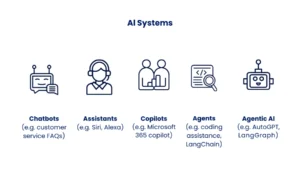
Agentic AI: From Conversations to Autonomous Action
The agentic AI evolution is the move towards action, rather than dialogue. In the evolution of agentic AI’s, systems do not execute scripts, but they have goals. They can strategize on actions, choose instruments, and execute tasks on their own. This is an ability that distinguishes between agents and conventional chatbots.
The Agentic AI chatbots are a combination of reasoning, memory, and orchestration layers. They communicate in systems rather than individual interfaces. Hybrid Chatbot architectures are embraced at this period by many enterprises. Hybrid models create a compromise between control and generative flexibility.
Onboarding, approvals, reporting, and system coordination are some of the workflows supported by agentic systems. They decrease manual work and enhance efficiency. This phase is the point of changing the conversational AI into an enterprise execution layer.
The idea of agentic AI evolution transforms AI into assistance for collaboration. AI systems start to behave as digital teammates and not tools.
What Agentic Conversational AI Means for Enterprises
Agency conversational AI will mark a significant development among businesses. Nowadays, businesses are considering AI not only in the quality of conversation but also in terms of business performance. Operational value in modern systems is provided by automation, integration, and orchestration. This transition is a core issue in the current agentic AI evolution and indicates the way AI is able to complement the workflow on an enterprise scale.
Enterprise Capabilities Enabled by Agentic Conversational AI
Modern conversational AI solutions for enterprises provide end-to-end orchestration across systems, connecting CRMs, ERPs, analytics platforms, and internal applications seamlessly. AI chatbots in agency tasks can automate the tasks that needed to be done manually before, and thus, the teams can dedicate their effort to more valuable work. These systems have the benefit of boosting efficiency, minimizing errors, and enabling businesses to expand more rapidly.
Role of Multi-Agent AI Systems in Enterprise Workflows
Multi specialized agents can work together in complex workflows with the help of multi-agent AI systems. The agents cope with a particular domain, share the context, and coordinate the outcomes. Such distributed intelligence makes the enterprises perform parallel tasks in a cost-effective way, is reliable, and can be scaled. The multi-agent coordination enhances the entire agentic AI evolution in the organization, as it makes operations more intelligent and robust.
Governance, Strategy, and Enterprise Readiness
Using agency AI should be planned, governed, and strategized. The chatbot strategy consulting assists an organization in identifying organizational goals, risk management policies, and performance measures. Formal governance provides adherence, scalability, and uniformity between the enterprise processes. The potential of agentic AI chatbots is constrained unless there is a clear plan to ensure that even advanced AI systems are not inefficient, misaligned, or contain operational errors.
Importance of the Right AI Development Partner
When collaborating with a seasoned AI development company, it is guaranteed that the agentic AI systems will be successfully implemented. System architecture, integration, and lifecycle management. Professional AI Chatbot development services. Such services assist businesses with scalable, safe, and sustainable solutions, leading to their long-term success in the agentic AI evolution and the biggest possible impact on their operations.
Conclusion
The future of enterprise intelligence is agentic AI evolution in which chatbots can leave the reactive assistant role and become autonomous partners. Contemporary agentic AI chatbots process tasks, organize multi-agent processes, optimize operations, and act similarly to a human being. Businesses that use conversational AI solutions for enterprises to support enterprises and multi-agent AI systems achieve business value and better decision-making, which are quantifiable. The collaboration with AnavClouds Analytics.ai, which offers expert AI Chatbot development services, strategy consulting, and integration options, is needed to implement this future-ready AI. They have the expertise necessary to facilitate a smooth and agentic AI evolution to make sure that organizations can afford to adopt intelligent, adaptive, and scalable AI concepts.