

AI in hospitality refers to the use of machine learning, natural language processing, computer vision application, and generative AI to personalize guest experiences, automate hotel operations, and optimize pricing and service decisions in real time. AI in hospitality sector is no longer an “experimental” venture for hotels. It’s a tactic that major brands are implementing, tracking, and expanding. AI is subtly yet effectively transforming every interaction, from initial room search through to checkout. But for those who have not paid notice to this change, the clock is ticking on them.
What Does AI in Hospitality Actually Mean?
Let’s clear something up first. Yes, some robots carry luggage and futuristic check-in screens, but that’s not the end of it; there’s more to it than that. It’s a wide range of technologies such as machine learning, natural language processing service, computer vision, generative AI and predictive analytics — all used to create a very human sense of welcome, comfort and value for the guest.
AI in hospitality sector means that a hotel is aware of your room temperature preference before you even get there. It’s a chatbot that can solve your complaint at 2 AM just as effectively as your best front desk agent. It’s an ability to adjust room rates in real time based on the local demand, weather, competitor availability, and dozens of other factors — no matter who is touching a spreadsheet.
The essence of hospitality AI solutions is that they are designed to streamline, personalize, and provide more informed decision-making in a more timely manner.
Key Areas Where AI in Hospitality Is Making the Biggest Impact
1. Guest Personalization at Scale
Personalization has been a buzzword in the hospitality industry for quite some time. AI in hospitality delivers on it. Machine learning in hospitality sector can be used to tailor experiences to individual guests by analysing past preferences (eating and sleeping habits, complaint behaviour, loyalty levels, etc.).
Someone who always asks for a vegetarian meal at the table and sets the thermostat at 68° should not have to ask for either again. AI systems can do these preferences with ease. That’s what makes a home feel thoughtfully designed and one that feels like a cookie-cutter.
Generative AI in hospitality is taking this even further. Hotels are now leveraging LLMs to create personalized welcome messages, customized local itineraries, and even real-time upsell suggestions tailored to each guest’s profile and travel objectives.
2. AI Chatbots for Hotels — Smarter, Faster, Always On
Hotels can utilize AI chatbots to a great extent. Fifth-year-old rule-based bots are out of the picture. Today’s hospitality AI solutions leverage conversational AI that is context-aware, multilingual, and has natural language understanding to address complex guest inquiries, rather than FAQs.
Currently, 65% of all hotels globally are using AI-powered chatbots to respond to customer inquiries around the clock, cutting down the average response time from 15 minutes to 45 seconds. This is a game-changer for high-volume properties on every level of guest satisfaction rating and for staff workload management.
The AI-powered hotel chatbot doesn’t just take your questions; it can also modify bookings, arrange for room service, make local suggestions, and even collect feedback after guests have checked out to provide a better experience. All these features are performed within the same conversation flow in WhatsApp, web chat, or in-app messaging.
3. Dynamic Pricing and Revenue Optimization
One of the oldest sciences in the hotel business is revenue management. AI in hotel management has been completely revolutionized. AI in hospitality industry helps; machine learning analyzes numerous data points, such as historical occupancy rates, local events, competitor pricing, macroeconomic indicators, and social media sentiment, to dynamically and in real-time adjust room pricing.
This is one of the most obvious examples of ROI for hospitality AI solutions, and that’s why revenue management AI has been adopted in the hospitality sector more quickly than anywhere else.
4. AI Customer Service: Reducing Friction Across Every Touchpoint
AI customer service for the hospitality sector goes beyond bots. Imagine automated check-in kiosks that recognize guests by facial recognition, smart concierge apps, AI-driven complaint resolution, and sentiment analysis of guest reviews, all contributing to a flawless service experience.
One of the specific areas where AI in hospitality is a strong asset is in predicting service gaps before they ever turn into negative reviews. Sentiment analysis tools can identify early signs of dissatisfaction, such as a guest who made a request for room service twice, but only replied briefly to check-in messages, and warn their employees to contact the guests before they depart.
5. AI Marketing Automation — Targeting the Right Traveler, Every Time
In hospitality marketing, the traditional segmentation strategy has been based on broad segments such as business travellers, leisure travellers, and families. AI marketing automation opens up the door to this vast potential. Hotels can now create micro-campaigns that specifically target highly targeted traveller segments such as solo female business travellers who want to stay on a high floor, couples who want to book an anniversary getaway in the next 30 days, loyalty members who haven’t stayed in the hotel for 6 months.
Examples of AI applications in hospitality marketing are personalized email campaigns, offer targeting in real-time, predicting customer churn in loyalty programs, and automated social retargeting using booking intent signals.
The result? Conversion rates, cost per acquisition, and guest relationships that are truly personal and not mass market.
Your guests expect smart. Your operations demand it. Here’s how AI in hospitality changes everything.
How Is Generative AI Used in Hospitality?
The use of generative AI in hospitality sector should be given a special mention. Generative AI solutions are all about creation, whereas previous forms of AI were about automation and prediction.
Hotels are using generative AI to:
- Write personalized pre-arrival emails tailored to each guest’s trip purpose and preferences
- Generate dynamic property descriptions that adapt for different booking platforms and traveler segments
- Create AI-powered virtual concierges capable of answering complex, multi-step questions about local attractions, transportation, and dining
- Produce multilingual guest communications instantly, without a translation team
- Support staff with AI co-pilots that suggest the best response to difficult guest complaints in real time
In the hospitality sector, generative AI solutions prove to be especially powerful due to the role of language and communication in the industry. Each interaction a guest has with your business, whether it’s when they book a room, receive a message while they’re still in the room, or a survey after they leave, is a content opportunity. All of those touch points get made sharper, faster, and more personalized with generative AI in hospitality.
What Are the Top AI Use Cases in Hospitality?
Let’s take a quick peek at the best AI use case scenarios in hotel operations today:
Front-of-House Operations
- AI chatbots that can respond to queries on the web, app, and messaging platforms, around the clock.
- Enabling contactless check-in and facial recognition for keyless entry.
- AI-powered digital concierges for dining, activity, and transport bookings.
Back-of-House Operations
- Predictive maintenance, which is the use of AI to monitor HVAC units, elevators, and kitchen equipment to alert to potential problems before they cause a breakdown.
- Smart housekeeping scheduling by indicating the room’s occupancy condition through a signal to route staff members using real-time information
- Tools that optimize the workforce in response to predicted demand.
Revenue and Commercial
- Dynamic pricing engines fluctuate prices according to demand signals.
- AI-driven marketing automation for customized emails, push, and paid retargeting advertisements.
- Upsell and cross-sell engines that suggest room upgrades, dining packages, and spa bookings at the proper time.
Guest Intelligence
- Guest journey mapping is the process of monitoring guest satisfaction at each interaction point.
- Identifies patterns in thousands of feedback entries with the help of AI.
- Loyalty churn prediction models are useful to the retention team to take action before a guest leaves.
How Is AI Used in the Broader Travel Industry?
In the travel industry, AI is making significant strides beyond the confines of the hotel room. In the field of crew scheduling, airlines are leveraging machine learning to optimize their operations and reduce costs. AI is also reshaping the broader travel industry. Airlines use machine learning solutions to optimize crew scheduling and reduce costs, online travel agencies use it to personalize search results and streamline bookings, and car rental companies use predictive analytics for fleet optimization. For hotels, this matters because AI can detect patterns in an OTA guest’s search behavior, destination interests, and past travel habits — informing pre-arrival communications and offers personalized to that guest before they even arrive.
AI in hospitality combined with AI in travel is a golden opportunity for the hotel industry, especially when it comes to knowing what the guests want even before they step inside.
This cross-industry connectivity is among the reasons that AI development services are now a strategic investment priority for large hotel groups, independent properties, and regional hospitality brands alike.
What’s Next: Trends Shaping AI in Hospitality Through 2027
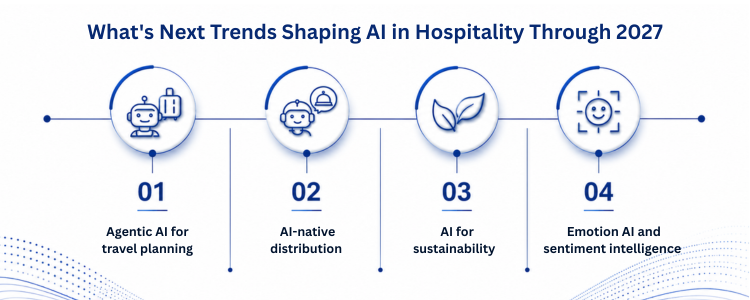
Agentic AI for Travel Planning
Conversational, agentic booking engines: These are taking the place of the old form-filling and are beginning to use natural language. If a traveller is using an AI agent that can compare 50 properties, read thousands of reviews, and find rates that are available in real-time and negotiate the rates in seconds, hotels must have systems that can match this speed and complexity. Hospitalityupgrade
AI-Native Distribution
Hotels are starting to organize their information and pricing so it’s understandable to AI travel agents, and not just human ones. It’s a basic paradigm change in the way room inventory is discovered and booked.
AI for Sustainability
Energy management AI isn’t a luxury anymore. Occupancy sensors that control power usage based on the number of guests in a room will enable hotels to achieve their ESG goals and save on energy bills.
Emotion AI and Sentiment Intelligence
Next-generation AI customer service tools will read emotions from text, voice, and even facial expressions to adjust customer service responses in real time, only escalating to a human agent where empathy and complicated problem-solving are required.
Conclusion
The hospitality sector is at a true turning point. It’s not just about proof of concept any longer, as AI in hospitality industry has become a key component of the way top brands drive personalization, operational efficiency, and revenue growth. The hotels that are going to prosper in the coming decade do not always have to have the largest room count or the richest bank accounts. They are the ones who will master the use of data, optimize automation, and leverage the power of AI to ensure that every guest interaction is more human, never less. We are experts at applying AI development services to produce tangible results, whether that’s machine learning for the hospitality sector or complete generative AI solutions designed for hands-on use. Whether you’re looking at machine learning in hospitality industry or end-to-end AI solutions for real-life applications, AnavClouds Analytics.ai is dedicated to bringing measurable benefits to your business.
FAQs
1. What is AI in hospitality and why does it matter?
AI in hospitality involves leveraging AI technologies, such as machine learning, NLP, and automation, to improve the guest experience and streamline operations. It is important because it allows the hotels to offer bespoke service to many and also to be more efficient.
2. How do AI chatbots for hotels improve guest experience?
AI chatbots can answer guest questions instantly, around the clock, whether it’s about booking a change, requesting room service, or any other query, ensuring a uniform level of service and decreasing wait times across all communication channels.
3. What are the most common AI use cases in hospitality today?
Use cases of AI in hospitality sector range from dynamic pricing, personalized recommendations, predictive maintenance, contactless check-in, AI-powered chatbots, staff scheduling optimization, to AI marketing automation.
4. Is generative AI in hospitality already being used by hotels?
Yes. Hotels are leveraging generative AI solutions to enhance guest communication, build multilingual content, provide virtual concierge services, and even support their staff with live recommendations for responses.
5. How much does it cost to implement AI in a hotel?
Costs vary widely based on scope — a basic AI chatbot can start in the low thousands, while enterprise-wide AI systems (dynamic pricing + personalization + automation) can run into six figures. Most hotels start with one high-ROI use case, like chatbots or dynamic pricing, before scaling.
6. What’s the difference between AI and generative AI in hospitality?
Traditional AI in hospitality focuses on automation and prediction (chatbots, dynamic pricing, predictive maintenance). Generative AI goes further by creating new content — personalized emails, itineraries, and multilingual guest messaging — tailored to each guest in real time.