
All businesses are scrambling towards AI. Everything is automation, predictive analytics, generative AI solutions, intelligent decision-making, and the ambition to do it all. However, there is one aspect between the companies that achieve actual outcomes and those that remain in an infinite pilot: Data readiness for AI.
A survey of 248 data management leaders in Q3 2024 found that 63% of organizations are not sure whether they have the right data management practices to support AI. It was also estimated that by 2026, 60% of AI projects will be dropped by organizations because the data to support them is not available.
That is not a technical issue. It is a strategy problem. It begins with one simple question: Is your data really ready?
What Is Data Readiness for AI — And Why Does It Go Beyond “Clean Data”?
The condition of data that is accurate, accessible, governed, and structured sufficiently to be dependable on training, deploying, and scaling of AI systems is known as data readiness for AI.
This is where most teams fail; however, they do not see data readiness for AI as anything more than they do for traditional data hygiene. Gartner explains this comparison perfectly: data of high quality according to traditional standards does not necessarily constitute AI-ready data. Representative data (full of outliers and edge cases) needed to train an AI model are sometimes filtered out by regular cleansing procedures.
The actual data readiness for AI is ever case-specific. The information that a customer churn model needs is a very different type of information from what a generative AI development application or a demand forecasting engine would need. This is the basis of any plausible AI development plan – aligning your data with your desired result, not with some generic cleanliness.
At its core, data readiness for AI sits across four dimensions:
- Quality — Is the data accurate, consistent, and complete?
- Accessibility — Can AI systems retrieve and use the data without friction?
- Governance — Is there a clear framework for data ownership, usage, and compliance?
- Structure — Is the data formatted in a way that AI models can actually process?
Why AI Data Readiness Is a Leadership Priority, Not Just an IT One
There is a tendency in organizations to push AI data readiness (AIDR) down to the data engineering team and treat it as a backend concern. That framing is one of the more expensive mistakes a business can make.
The hard truth is that a significant number of AI initiatives fail to meet expected outcomes — and in most of those cases, the model itself was not the problem. The data beneath it was. When teams rush into AI adoption without first addressing the quality and structure of their data foundations, the consequences ripple outward quickly:
- AI models that produce inaccurate, biased, or unexplainable outputs
- High rework costs when data pipelines break mid-deployment
- Delayed timelines on AI development services rollouts
- Erosion of stakeholder trust in AI decision making
As a Salesforce data expert, it: “An AI strategy without a data framework is just a wish list. Attempting to deploy AI agents without one lead to inconsistent results, security risks, and a lack of user trust.”
Organizations that invest in AI data management before they deploy consistently outperform those that retrofit it afterward — in speed, accuracy, and ROI.
How to Evaluate Your Data Readiness for AI: A Step-by-Step Framework
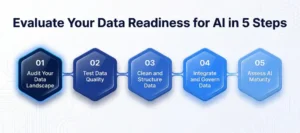
Step 1: Conduct a Full Data Landscape Audit
The first step toward genuine data readiness for AI is understanding exactly what data you have, where it lives, and in what shape it is.
A structured data audit map:
- Where data is stored — databases, warehouses, data lakes, SaaS platforms
- What format is it in — structured, semi-structured, or unstructured
- Who has access to it and under what conditions
- How frequently is it updated and by whom
This step alone reveals more about your AI data readiness than most technical assessments. You cannot make good AI decisions based on data you do not fully understand. Visibility comes first.
Step 2: Assess Data Quality Across All Critical Dimensions
Data quality is the most discussed dimension of data readiness for AI — and the most frequently underestimated. Organizations that skip this step pay for it when their AI models underperform or return unreliable outputs.
When assessing quality for AI data readiness, look at:
- Completeness — Are there significant gaps or missing values across key datasets?
- Consistency — Is the same data represented uniformly across systems? For example, is your country field always “India” — or sometimes “IN” or “IND”?
- Accuracy — Does the data reflect reality, or is it outdated and stale?
- Timeliness — Is it fresh enough to support real-time AI use cases?
This is also where data silos become a major obstacle. When teams operate in isolation, data gets duplicated, contradicted, and disconnected. That fragmentation directly undermines generative AI readiness and makes it harder to build reliable AI solutions at scale.
Step 3: Evaluate Data Accessibility and Integration Infrastructure
Even high-quality data fails at data readiness for AI if your systems cannot access it efficiently. Fragmented data leads to fragmented AI — inconsistent outputs, broken pipelines, and unreliable decision-making across the board.
This is where AI data management infrastructure becomes a direct business enabler. Ask:
- Is there a centralized environment — a data warehouse, lake, or lakehouse — where AI tools can access what they need?
- Are APIs and connectors in place to allow consistent data flow across systems?
- Are there latency or bandwidth constraints that could affect AI model performance?
The smoother your data flows, the more reliably your AI solutions can perform across different AI use cases — from customer intelligence to operational automation.
Step 4: Review Your Data Governance Framework
Governance is where most organizations underinvest in their data readiness for AI journey — and then regret it when compliance issues, bias complaints, or audit failures emerge. A robust governance framework answers:
- Who owns data quality and accuracy across teams?
- How is sensitive or personally identifiable information (PII) handled?
- Are there clear data retention, access control, and audit trail policies?
- Is the organization compliant with relevant regulations like GDPR or HIPAA?
Gartner recommends that as AI initiatives scale, organizations rethink data management to focus on active metadata, which drives greater model accuracy, higher AI data readiness, and reduced compute costs.
Without governance, AI adoption becomes a liability. With it, it becomes a competitive advantage.
Step 5: Map Data Readiness for AI to Specific Use Cases
This is perhaps the most overlooked step in the entire data readiness for AI evaluation process. There is no way to make data AI-ready in general or in advance — the readiness of your data entirely depends on how and where it will be used.
A predictive maintenance model needs historical sensor data with timestamps and anomaly flags. A generative AI development application needs large volumes of well-labeled text or multimodal data. A fraud detection engine needs behavioral and transactional data at scale.
Mapping your existing data to your intended AI use cases is what separates a generic data audit from a real AI development strategy — one that is executable, measurable, and built to deliver outcomes.
Warning Signs Your Data Readiness for AI Needs Immediate Attention
Before moving forward with any AI initiative, watch for these red flags:
- Teams rely on manual data exports and spreadsheets to feed AI tools
- Multiple “single sources of truth” exist across business units and regularly contradict each other
- Data pipelines break frequently or require constant manual intervention
- There is no clear data ownership across departments
- Previous AI pilots produced unreliable, inconsistent, or unexplainable results
If any of these apply, the problem is rarely the AI model itself — it is the data foundations beneath it.
Building Stronger Data Foundations for Sustainable AI Adoption
Having a clear view of your data being AI-ready, the next thing to do is to invest in a handful of high-leverage areas:
- Unify your data infrastructure: Shift to a centralized data environment and do away with silos and ensure that data is accessible to AI tools and groups regularly.
- Standardize processes and naming conventions: Generative AI needs uniform formats, field definitions, and data entry standards across every system.
- Build data literacy across your teams: It is not sufficient to use technical infrastructure. Individuals should know the direct effect of data quality on AI results.
- Start focused, then scale: Select one of the AI use-cases with high value and prepare that data, deploy it, learn, and scale it. Attempting to convert all data to AI simultaneously is generally a cause of stalled programs.
- Work with the right AI consultancy partner: The right partner makes your time shorter by a lot. They carry with them established frameworks, the right equipment, and industry-based experience that transforms data readiness for AI from a mere theoretical practice into a roadmap that can be implemented. An established AI consultancy partner is among the best leverage investments that can be made by an organization with serious intentions to adopt AI.
Final Thoughts
The AI-winning organizations are not necessarily the ones with the largest budgets. It is they who took the issue of data preparation seriously before scaling in the case of AI. They were honest in auditing, they were purposeful in governing, and they created databases that could potentially support the burden of production-level AI.
The process of data readiness for AI cannot be a single project, but needs to be a discipline, continually developing as your AI goals, your data volumes, and your regulatory landscape continue to change. Developing that habit at present is the difference between those organizations that test AI and those that operationalize it.
We are AnavClouds Analytics.ai, where we assist businesses in transforming their data into a real AI benefit. Our certified AI experts will collaborate with your team to develop your data workplaces, the foundation of AI performers, not just in pilots, but in production too, as you go through the continuum of AI data management, data engineering, generative AI solutions, and end-to-end AI development services. In case you are willing to consider and enhance your data readiness for AI, we are willing to assist you in making that step.
FAQs
What is data readiness for AI?
AI data preparedness refers to your data being precise, available, and controlled suitably to allow AI systems to train and make reliable and consistent results with certainty.
How do I know if my organization’s data is AI-ready?
Start with a data audit. In case of siloed, inconsistent, or unowned data, then your data is not ready to be used by AI, and that should be improved before any AI implementation.
How long does it take to achieve data readiness for AI?
It varies. One focused AI application can achieve maturity in a few weeks. The time required to prepare enterprise-wide data to be ready to be used by AI can vary between several months, based on the complexity of the infrastructure used.
Do small businesses need to worry about data readiness for AI?
Yes. A smaller organization also does not experience as much information fragmentation, and the preparation of data to use AI is therefore more feasible, although the process of evaluation remains significant despite the size of the company.