
Think about the last time you actually walked into a bank branch. For most people, it’s been a while. And that’s not by accident — it reflects how dramatic customer behavior has shifted over the last decade. People want answers now, not after sitting on hold for twenty minutes. They want their bank to know who they are, understand what they need, and help them without requiring them to explain the same issue to three different people.
That’s exactly the gap that AI chatbots for banking were built to fill. More and more financial institutions are turning to AI chatbots for banking to stay competitive and meet rising customer demands. And institutions that have figured this out aren’t just cutting operational costs — they’re building the kind of customer trust that holds up over time.
What Are AI Chatbots for Banking?
Before getting into what these tools can do, it’s worth understanding what they actually are — because “chatbot” still carries baggage from an earlier era of frustrating, dead-end automated menus that pushed customers away rather than helping them.
Today’s banking AI chatbots are a different breed entirely. Built on natural language processing and machine learning, they understand what a customer is genuinely trying to say — not just whether a keyword matched a script. A customer typing “I think someone used my card without my knowledge” gets a very different, contextually relevant response than someone asking, “what’s my current balance.” The system reads intent, not just input.
With the global AI in banking market projected to reach $299 billion by 2033, it’s clear that financial institutions aren’t treating AI chatbots for banking as pilot experiments anymore — they’re embedding them into the core of how they serve customers. These systems learn continuously, improve with every conversation, and can manage thousands of simultaneous interactions without any drop in quality or consistency. No human team, however skilled, can do that at scale.
Key Benefits of AI Chatbots for Banking Operations
AI chatbots for banking are not simply a customer service upgrade. They touch nearly every layer of how a bank functions — from customer-facing support to internal compliance workflows. The returns show up across satisfaction scores, fraud losses, operational budgets, and staff productivity, often all at once.
Whether you’re a large commercial bank or a growing digital-first institution, AI chatbots for banking offer a clear path to serving more customers with fewer resources. Here’s where the real value shows up:
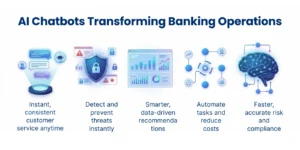
Always On, Always Consistent
A customer trying to block a card at midnight doesn’t care that it’s outside business hours. AI chatbots for banking are living around the clock, responding to those moments without delay. More importantly, they’re consistent — they don’t have off days, they don’t misremember policy, and they don’t give one customer a different answer than they gave the last. This kind of reliability is something banks have historically struggled to deliver at scale, especially across large and geographically spread customer bases.
Fraud Detection That Doesn’t Wait
Traditional fraud detection has mostly been reactive — something goes wrong, and then someone investigates. AI chatbots in banking change that dynamic. By analyzing spending patterns in real time and flagging anything that looks out of the ordinary, they alert customers immediately — sometimes before a suspicious transaction even completes. That speed matters in a way that’s hard to overstate. The window between a fraud attempt and irreversible damage can be minutes, and AI banking chatbots are built to operate in that window.
Financial Guidance That Feels Personal
Genuinely personalized financial guidance used to be the exclusive territory of private wealth advisors. Banking AI chatbots powered by machine learning solutions are changing. They analyze individual spending behavior and surface insights that are relevant — flagging a forgotten recurring charge, suggesting a savings approach based on real habits, or pointing a customer toward a product that fits their actual financial situation. It doesn’t feel like a generic recommendation because it isn’t one, and that difference matters to customers.
Leaner Operations Without Cutting Service Quality
When AI chatbots for banking absorb the high-volume routine work — balance inquiries, statement requests, PIN resets, basic troubleshooting — human agents are freed up for conversations that genuinely need human judgment. That’s better for the agent experience, better for customers with complex problems, and significantly better for the bank’s cost structure. This isn’t about replacing people; it’s about placing them where their skills make the most difference.
Smarter Internal AI Decision Making
Beyond what customers experience, AI decision making is quietly transforming internal banking processes. Loan eligibility checks, credit risk assessments, compliance reviews — these workflows move faster and more consistently when AI solutions are supporting the evaluation. Less room for error, reduced processing time, and a cleaner audit trail across the board.
Top Use Cases of AI Chatbots in the Banking Industry
Understanding the benefits of theory is one thing. Seeing how banks are deploying AI chatbots for banking in the real world tells a more useful story. Across retail, commercial, and digital-first institutions, the applications are specific, practical, and deliver measurable results. Here’s where AI chatbots in banking are showing up most consistently.
Everyday Account Management and Self-Service
The most common starting point for banks deploying AI chatbots for banking is routine account management. Balance checks, transaction reviews, address updates, statement requests — these are high-frequency, low-complexity interactions that chatbot integration services handle instantly. When customers get answers in seconds rather than waiting in a queue, satisfaction improves, and pressure on support teams drops at the same time.
Guiding Customers Through Loan Applications
The loan application process has historically been one of banking’s most friction-heavy experiences — long forms, unclear requirements, multiple follow-up calls. AI chatbots for banking are changing by walking customers through the process conversationally, answering questions in plain language, collecting required information step by step, and giving preliminary eligibility feedback quickly. What used to feel intimidating starts to feel straightforward.
New Customer Onboarding
Onboarding drop-off is a real problem banks deal with constantly. Customers who sign up but never fully activate represent a significant missed opportunity — and it often comes down to a confusing or effort-heavy setup process. AI chatbots for banking guide new customers through account activation, KYC verification, and product orientation in a way that’s clear and human, without requiring a branch visit or a phone call.
Payments and Fund Transfers
Modern AI banking chatbots aren’t just informational — they’re transactional. Scheduling payments, initiating transfers, and confirming wire instructions — these interactions can be handled through a conversational interface when the right security protocols and chatbot integration services are in place. The experience feels intuitive in a way that even well-designed banking apps sometimes don’t quite achieve.
Internal Compliance Support
AI chatbots in banking are also being deployed internally to help compliance and operations teams quickly surface relevant policies, regulatory requirements, and procedural guidance. In an environment where a single compliance misstep can result in a significant penalty, having fast, reliable access to the right information is genuinely valuable — and reduces the risk of decisions being made on incomplete knowledge.
Complaint Handling and Escalation
One of the more nuanced use cases for AI chatbots for banking is sentiment-aware complaint resolution. When a chatbot picks up frustration — through word choice, repeated queries, or escalating tone — it can hand the conversation to a human agent at exactly the right moment, passing along full context. The customer doesn’t have to start over. The agent already knows the situation. That handoff quality is what separates a good deployment from a frustrating one.
What to Look for in AI Chatbot Development Services for Banking
Deciding to invest in AI chatbots for banking is the straightforward part. Choosing the right AI chatbot development services partner — and making sure the implementation delivers in a live environment — is where most institutions stumble.
A chatbot that misunderstands customers, gives inconsistent answers, or fails to connect with existing systems doesn’t fail quietly. It actively erodes trust. So before committing to a vendor, the right questions need to be on the table.
Does the chatbot maintain context across a full multi-turn conversation, or does it lose track after the first exchange? Getting this right is fundamental — it’s what separates AI chatbots for banking that customers return from ones they abandon after a single frustrating interaction. Can it connect cleanly with your core banking platform, CRM, and compliance tools — or will it operate in a silo? Is it built to meet the security and regulatory requirements your institution is accountable to — GDPR, PCI-DSS, and applicable regional standards? Does it support the languages your customer base actually uses? And when a conversation needs a human, does the escalation happen smoothly — or does the customer have to explain everything twice?
The right AI chatbot development company brings clear answers to these questions before the project starts, not as afterthoughts during implementation. And a skilled team offering end-to-end AI development services will also help map out integrations, set realistic timelines, and build in testing protocols that reflect real usage — not ideal conditions.
How Generative AI Development Services Are Reshaping AI Chatbots for Banking
The current generation of AI chatbots for banking is genuinely capable. The next generation is going to operate at a different level. Generative AI development services are moving the capability of ceiling from “answers questions accurately” to “anticipates what the customer needs before they ask.”
For organizations already using AI chatbots for banking, generative AI is the natural next investment. That looks like drafting a personalized financial summary without being prompted, proactively flagging a change in spending behavior before the customer has noticed it themselves, or explaining a complex financial product — a variable rate mortgage, a structured deposit — in language that makes sense to the person reading it, not the compliance team that wrote the original brief.
For banks, this shift from reactive to anticipatory service isn’t just a product feature. It’s a competitive differentiator that compounds over time — because customers who feel genuinely understood by their bank don’t go looking for alternatives when rates change, or a competitor runs a promotion.
Final Thoughts
The honest answer to where this leaves banks that haven’t invested in AI chatbots for banking yet — they’re further behind than most of them realize. The gap between institutions that have committed seriously and those still evaluating isn’t narrowing on its own. Customer expectations are rising faster than most organizations’ willingness to adapt, and the banks getting this right are raising the bar for everyone else in the process.
This isn’t about chasing technology for its own sake. It’s about meeting customers where they already are — expecting fast, intelligent, and genuinely personalized service — and building the kind of institutional trust that holds up across market cycles, rate changes, and competitive pressure.
At AnavClouds Analytics.ai, we work with organizations serious about making AI solutions in banking deliver real, measurable outcomes. From machine learning solutions and AI development services to full-scale AI chatbot development services and chatbot integration services, our team of 50+ certified AI experts helps institutions move from concept to production faster and with greater precision than going it alone. Ready to explore what AI chatbots for banking can do for your institution? Let’s talk.
FAQs
What is an AI chatbot in banking?
An AI chatbot in banking is a virtual assistant that uses artificial intelligence to handle customer queries, account tasks, and transactions automatically — anytime, without needing a human agent.
Are AI chatbots safe to use in banking?
Yes. Banking AI chatbots are built with encryption, authentication protocols, and regulatory compliance standards to keep customer data and financial transactions secure.
How do AI chatbots for banking help reduce costs?
AI chatbots for banking automate high-volume routine tasks, reducing pressure on human support teams and cutting operational costs while maintaining consistent service quality.
What happens when a banking chatbot cannot resolve an issue?
AI chatbots in banking escalate to a human agent seamlessly, passing full conversation context, so customers never have to repeat themselves from the beginning.