The manufacturing process is changing at a high pace, and there are demands for speed, accuracy, and efficiency of operations. The conventional automation systems have a hard time keeping pace with the real-time interference, compound workflow, and fluctuating production requirements. Agentic AI in Manufacturing presents a high level of autonomy where factories are monitored, learned, and act on their own. Using AI agents in manufacturing, with continuous optimization, businesses will be able to decrease downtime, enhance quality, and have scalable performance in the production process. This is a revolutionary technology that is driving the future of automation in manufacturing as it is assisting businesses remain competitive, and at the same time minimizes reliance on manual operations.
What Is Agentic AI in Manufacturing?
The term Agentic AI in Manufacturing describes innovative types of AI that have the ability to think, make decisions, and take action independently in a manufacturing context. These systems are goal-oriented agents; they know what to accomplish and take actions on their own. The agentic systems improve the traditional automation concept by never stopping to learn the results of their actions and can further optimize production processes.
Manufacturing Artificial intelligence has been traditionally related to data analysis, prediction, and decision support. In the case of Agentic AI in Manufacturing, this role is extended through the combination of intelligence and actions, were, instead of being triggered by a human agent all the time, the actions can be performed automatically. AI agents in manufacturing are used to monitor the condition, process real-time manufacturing analytics, and dynamically react to changes. This approach supports autonomous AI in manufacturing by enabling factories to operate as self-directed and self-improving systems. Agentic intelligence becomes essential in providing speed, accuracy, and scalability in modern processes as manufacturing automation evolves.
How Agentic AI Differs From Traditional AI in Manufacturing
The conventional artificial intelligence in manufacturing relies on pre-programmed rules, fixed models, and decision processes that are initiated by humans. These systems are analysis, prediction, and recommendation-oriented, not execution-oriented. In the case of some unforeseen interruptions, the response time becomes slower, as the decisions are still to be confirmed manually. This restricts the usefulness of automation in production in a rapidly evolving setting.
Agentic AI in Manufacturing is autonomous, intentional, and adaptable, thus allowing systems to behave. AI agents in manufacturing can process and recognize real-time manufacturing analytics, scan the circumstances of operation, and make decisions in real time. Autonomous AI in manufacturing continuously learns the results, which enables production systems to become better without necessarily involving human intervention.
Key differences include:
- Autonomous decision-making: With autonomy, agentic AI makes decisions, whereas traditional AI relies on analogous rules and human consensus.
- Goal-driven actions: Agentic systems work towards set goals, as compared to conventional AI, which works through pre-determined procedures.
- Continuous learning: Agentic AI becomes a better model as time passes through feedback, whereas traditional models do not.
- Proactive optimization: Agentic systems preempt problems and optimize processes, rather than responding to problems.
Why Manufacturing Needs Agentic AI Today
The pressure on manufacturing enterprises is increasing to operate more efficiently than ever, faster and smarter. The conventional manufacturing automation and non-portable AI systems cannot maintain the pace of real-time disruption and the demands of production. The Agentic AI in Manufacturing presents autonomous intelligence offering systems the possibility to adapt, make decisions, and act in the complex environments of manufacturing.
Rising Operational Complexity Across Manufacturing Ecosystems
Contemporary manufacturing systems are comprised of connected machines, online platforms, and international palisades. The fact of high demand variability and production variability makes operations more complex. Agentic AI in Manufacturing enables intelligent coordination across systems by continuously analyzing conditions and optimizing workflows. This reduces inefficiencies while maintaining consistency at a scale.
Increasing Demand for Real-Time Decision-Making
The manufacturing processes produce large amounts of machine and sensor real-time manufacturing analytics. Failure to make decisions in time results in production being lost as well as opportunities to optimize being lost. Autonomous AI in manufacturing transforms live data into immediate actions. This enhances responsiveness, precision, and production performance.
Limitations of Human-Dependent Manufacturing Operations
Human-controlled surveillance creates delays, mistakes, and scalability issues in manufacturing processes. Lack of skilled labor also affects the reliability and consistency of operations. Agentic AI in Manufacturing minimizes the reliance on human supervision at all times. Self-controlled systems are resistant to failure, maintain control, and performance even in hectic environments.
Key Use Cases of Agentic AI in Manufacturing
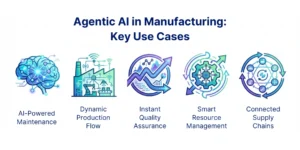
Agentic AI in Manufacturing is changing the contemporary factory by automating the sophisticated processes and steering intelligent decision-making. Such systems not only analyze the information, but also implement actions without human intervention, and production processes are quicker, more reliable, and efficient. AI agents in manufacturing are being applied across multiple critical areas to maximize productivity and reduce operational risk.
Predictive Maintenance and Equipment Optimization
The Agentic AI in Manufacturing is used to monitor the health status of machines, performance metrics, and operational patterns continuously. AI agents identify wear-out, or possible failures smartly and automatically trigger maintenance to be taken. This preventive strategy minimizes unplanned downtime, increases the life of equipment, and makes production processes smoother and more predictable.
Intelligent Production Scheduling and Resource Allocation
AI agents in manufacturing modify production schedules dynamically, based on the real-time demand, available capacity, and supply constraints. These systems maximize the use of workforces, use of machines, and energy use without the intervention of humans. The outcome is enhanced throughput, lessening bottlenecks, and bringing coordination between the production objectives and the business objectives.
Quality Control and Defect Detection
Real-time advanced sensing and analytics identify production outputs and are carried out by autonomous agents. Agentic AI in Manufacturing detects the quality violations and initiates corrective measures instantly. This will provide a stable quality of the product, reduce the amount of wasted material, and prevent expensive reworks or recalls.
Supply Chain and Inventory Optimization
The custom AI agent systems incorporate inventory levels with real-time production and demand data. Agentic AI in Manufacturing coordinates procurement, production, and distribution in a smart manner that would prevent cases of stockouts or overstocks. This will boost the efficiency of the supply chain, reduce the cost of operation, and increase flexibility to market changes.
Business Benefits of Agentic AI in Manufacturing
The concept of Agentic AI in Manufacturing is transforming the whole idea of operational excellence. Integrating Agentic AI with the help of an AI development company allows manufacturing plants to work independently and, at the same time, improve performance. These smart systems facilitate productivity, minimize risks, and increase the speed of decision-making. Companies that embrace Agentic AI in Manufacturing can unlock quantifiable efficiency, strength, and scalability in production processes, and such operations make businesses more competitive and future-proof.
Improved Operational Efficiency and Reduced Downtime
Agents reduce the number of production hiccups that turn into big issues because the agentic systems are autonomous and optimizing. Agentic AI in Manufacturing detects inefficiencies in real time and implements corrective action. This initiative approach saves time, costs of maintenance, and the production cycle across the facilities is smoother and uninterrupted.
Faster Decision-Making With Lower Human Dependency
The manufacturing AI agents make operational decisions in real-time and in a consistent manner, which eliminates the need to supervise human actions. This enables the teams to concentrate on strategic projects instead of normal surveillance. The Agentic AI in Manufacturing enhances speed of operation, enhances accuracy, and provides prompt reaction to shifting production states.
Increased Resilience and Production Agility
Autonomous AI in manufacturing adjusts the workflow dynamically when there are unforeseen breakdowns or variable demand. Uncertainty Agentic systems are stable to operate in the face of uncertainty and are also efficient in real-time production. This improves the general resilience of the system, and the manufacturers are in a position to react fast and keep the production going.
Better Alignment Between Production Goals and Business Objectives
The Agentic AI in the Manufacturing business will make sure that the operational decision is made according to the organizational priorities and performance indicators. Independent agents are maximizing processes according to the production goals and strategic aims. This enhances alignment among the working teams and the management and propels more of the same results and business value.
Scalable Intelligence Across Multi-Plant Manufacturing Operations
The AI agency recreates the best practices in several manufacturing locations and adapts to the local circumstances. AI-based agents offer uniform performance, operational visions, and decision-making independence within the facilities. This allows the growth to be scalable without the need to become more complex, allowing the manufacturers to grow intelligently and efficiently.
Conclusion
Autonomous, efficient, and intelligent production systems based on AI in Manufacturing is not just a technological upgrade, but it is a strategic enabler of agentic AI. With the help of AI agents in the manufacturing sector, businesses can achieve operational efficiency, resiliency, and better decision-making, and abate human dependence. Companies that embrace agentic systems can create a strong competitive edge through real-time manufacturing analytics, predictive intelligence, and self-optimizing processes. To manufacturers who want to access such possibilities, collaboration with a team of professionals in the field of AI development, such as AnavClouds Analytics.ai, will provide the option of scalable AI solutions and custom AI development services that can be used to generate a tangible business value and prepare businesses to operate in the future of autonomous manufacturing.
FAQs
What is Agentic AI in Manufacturing?
In the context of the Manufacturing industry, agentic AI can be described as intelligent systems that can reason, learn, and act independently to maximize manufacturing workflows and efficiency.
How does Agentic AI improve manufacturing operations?
In manufacturing, AI agents track equipment, change production plans, quality, and optimize supply chains in real time, and shorten downtime and costs.
What are the key benefits of adopting Agentic AI in Manufacturing?
Advantages are that it will enhance the productivity of operations and the speed at which decisions are undertaken, minimize dependency on human factors, enhance resilience, provide reliable quality, and be scaled to cover various facilities.
How can companies implement Agentic AI in Manufacturing?
The deployment of the Agentic AI by the companies can be done through collaboration with an AI development organization, such as AnavClouds Analytics.ai, to develop an AI agent, integrate, and provide real-time analytics solutions.